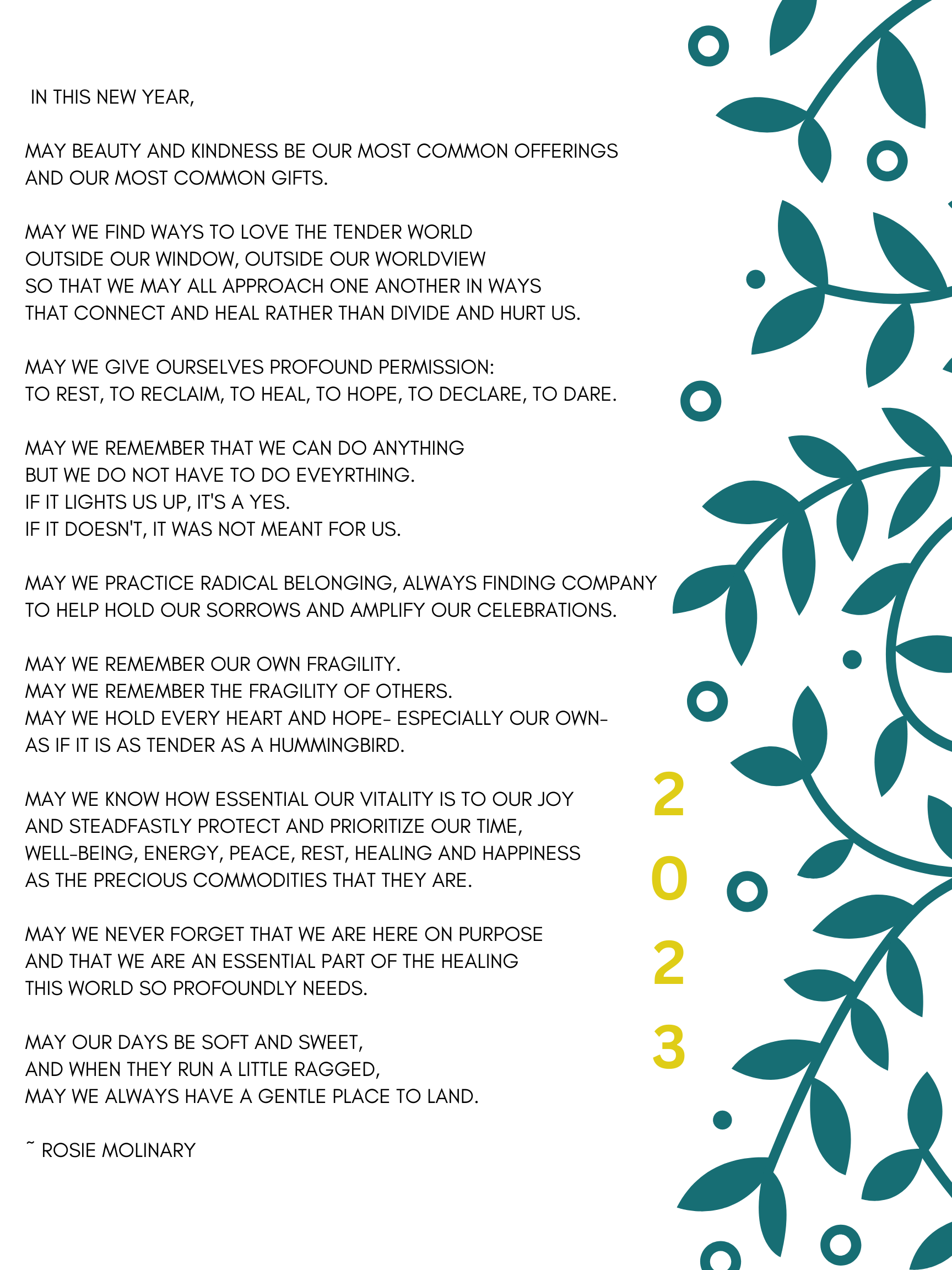
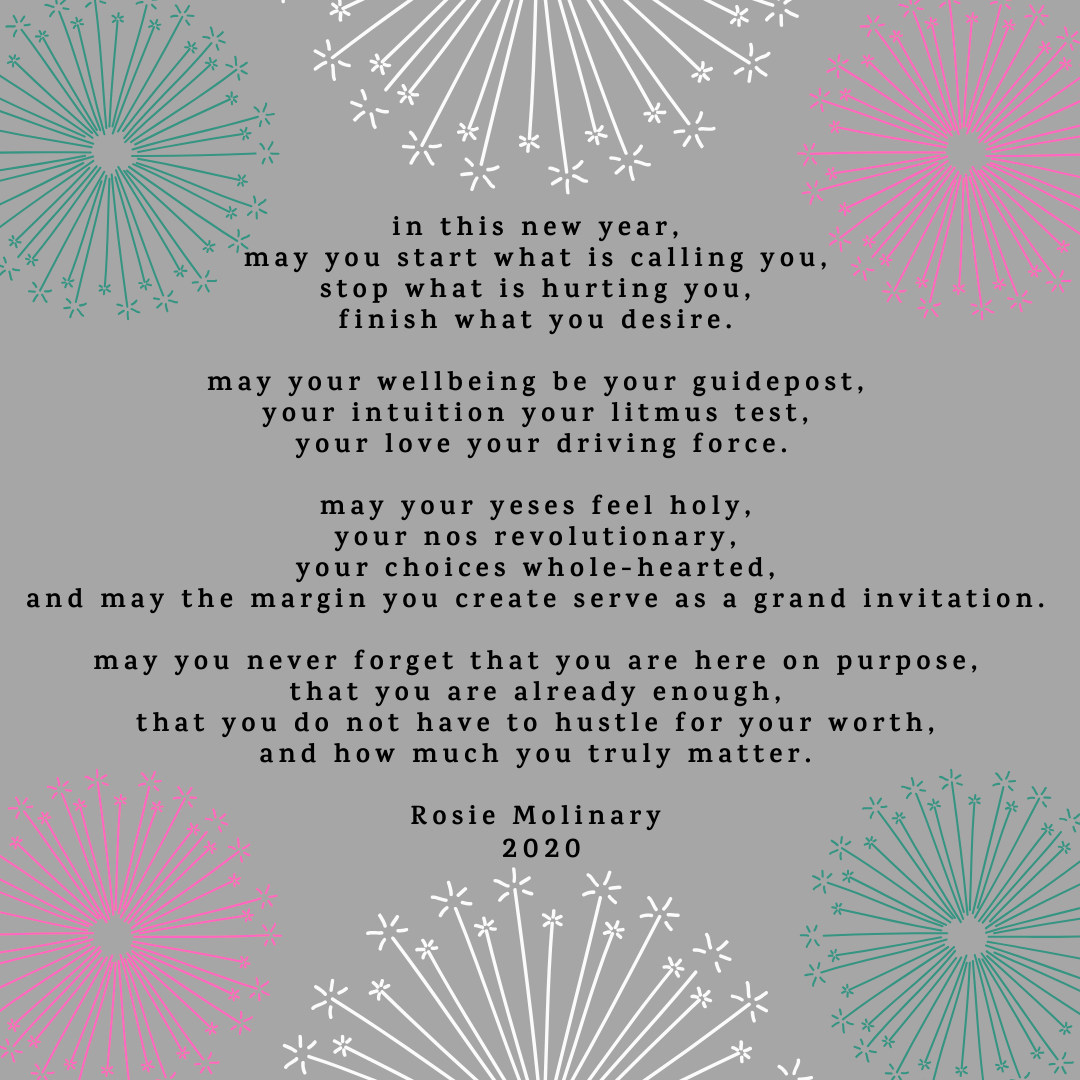
a wish for 2020
For the last few New Years, I’ve written a prayer/wish/blessing/intention/manifesto for the year.
May I always remember this guidance. May you always remember them, too. Welcome, 2020.
Announcing visionSPARK 2020
Are you ready to create your vision and define your intentions for 2020?
Would you like to claim how you most want to feel so you can choose actions that support your desire?
Would you like to build a foundation for the new year and the life you seek by gaining clarity, conviction and confidence in your vision?
If starting 2020 with clear intention speaks to you, join me for visionSPARK where you’ll capture your ideal year’s vision. You’ll imagine the possibilities, gather inspiration, and then chart your vision all while receiving thoughtful support.
Ultimately, you will leave visionSPARK with clarity about your 2020 passions and priorities, an inspirational vision board to root you, a touchstone word to reinforce your commitment during the year, a gentle and personal call to action to guide you, and the motivation to manifest the life you imagine.
$65 registration fee includes pre-workshop reflection guide, supplies, and refreshments.
(check out the fun add-on option on the registration page).
the power of a thought
 It’s been a minute since I’ve penned a little note to you (and me). The quiet was an unintended consequence of the busy-ness of life– of caregiving, showing up, being present, and healing.
If you were to ask me how life is, I would say, “All good. Nothing’s changed (and let’s knock on all the wood that that is true).” And then, the other day, I realized that while this year has maybe felt uneventful, I’ve actually been navigating a major event in my personal life that will impact the rest of my days.
As some of you may remember, last December, I woke up in the middle of the night to use the bathroom and as I got out of bed, I realized that the room was spinning out of control My legs gave out and I crashed into our dresser. After laying still for a couple hours, the spinning never lessened so I went to the emergency room at 5 AM where they checked me for a stroke or aneurysm and then treated me for vertigo. I went home that night exhausted but no longer spinning. A few days later, the spinning returned and I was back in the Emergency Room. This time when I went home, there was a roar of noise in my right ear. As December turned to January, the vertigo did not return but the tinnitus in my ear never stopped. A hearing test revealed that the virus* that caused my vertigo fried my auditory nerve, leaving me severely deaf in my right ear (*an MRI confirmed that the hearing loss and vertigo were not the work of a brain tumor).
Pretty immediately, I asked for a hearing aid. My doctor was both relieved and shocked as most adults who have hearing loss do not elect to use a hearing aid. And to be fair, the hearing aid didn’t give me back my hearing in the traditional way. If you are sitting on my right side and try to talk to me and there is any other noise going on, I cannot hear a word that you are saying. Even with the hearing aid, I cannot circumlocate sound (I tend to spin around in ALL the directions if someone calls out my name as I have no idea where the sound is coming from). But the hearing aid quiets the tinnitus (which is a sweet relief because having tinnitus is like having your brain constantly running an auditory marathon so it is profoundly mentally taxing and exhausting), and it gives me a more broad auditory experience of the world.
So I imagine that I have been more quiet this year because I am trying so hard to hear– hear the world and her people and all of their stories and to hear the quiet whisper from my soul of what I need to sustain myself in this new reality of my life.
But, then on Friday, I was participating in a yoga class that was part of a retreat on self-care that I was facilitating and the teacher said something that struck me in such a way that I wanted to share it.
We were doing tree pose– a standing posture that invites you to stand on one leg and then place the foot of the other leg somewhere on your plant leg. You might put it on the side of your calf or up above your knee, forming a little triangle off of your plant leg. Balance poses have always been hard for me but throw in my new aural challenges and, well, they are pretty close to impossible. So I would hold my tree pose for a few seconds and fall out of it and then begin again- over and over again.
And then the teacher encouraged us to keep our minds blank, to just breathe through the moments, and will our focus back to our breathing and the sensation in our body.
“A single thought can knock you over,” she explained.
A. SINGLE.THOUGHT.CAN.KNOCK.YOU.OVER.
And while in that moment, she may have been referring to our yoga practice, she was also referring to so much more– to how we can become consumed with a fear or worry or new thing in such a way that it derails us. To how we can work things over so much in our mind that it stops us from ever working them out in our lives.
Since Friday, I have been thinking about the power of our thoughts. How they can derail or inspire us. How they can lead us to victory or defeat. This morning, as I snapped my hearing aid battery shut and tucked it into my ear, I thought, “May I let what I hear in the world guide me and my thoughts inspire rather than derail me.” It was the tiniest of manifestos for this day but I offer it to you, too, in case it is also just what you needed to hear.
a wish for 2019
For the last few New Years, I’ve written a prayer/wish/blessing/intention/manifesto for the year.
May I always remember these truths. May you always remember them, too. Welcome, 2019.
Making Spirits Bright (or how to set an intention for the holiday season)
A poster for the Girls Empowerment Network Conference in Austin, Texas
If we aren’t careful, we can look up at the end of a holiday season and say, “wow, that didn’t go the way that I wanted it to go at all.” With so many expectations, invitations, and people involved, it’s pretty easy for us to just start saying yes without thinking through if the offer/opportunity/commitment also brings us joy in the holiday season.
If you already have a little dread about the next month, then setting an intention for the holiday season may be just the right strategy for you. An intention allows you to gently keep your priorities and values front of mind and, with just a little bit of reflection, it can help you gain clarity on what experiences and activities would support your intention this season. It’s a reminder, a prayer, a hope made known.
If you want to try intention setting this holiday season, here are some tips that might help.
Get quiet so you can get clear. Setting an intention really just starts by getting quiet and doing some reflection. To help you discover what you desire from this season, answer these questions in your head or on paper.
When you think about the holiday season, what do you most want from it?
What do you want to be doing more of? What do you want to be doing less of?
How do you want it to feel?
After you review those answers, you’ll have some clarity about what it is you most want and need from the holiday season and I encourage you to package that in one word (peace, presence, joy, gratitude, etc) or an easy phrase so that you can keep it front of mind and hold that value as a priority as you make your plans. If you like a good pun (and it’ll help you remember your intention), you can even package your intention with a holiday saying (Make Light, Making Spirits Bright, Silent Night, etc).
Survey the scene. If you are navigating the holidays with other people who might have their own desires, it could be helpful to ask those folks to also consider their intention for the holiday season. You can certainly use the same questions to help them discern an individual or a group intention. But, if they aren’t interested or the right age for that, you can at least get a sense of what is important to them about the season by asking everyone to share 3-5 things they love about the holidays or that they want to be a part of the celebration this year. Getting this insight helps you better discern what matters to everyone so that you can manage those expectations while living your intention. With these lists, you gain clarity on what you can let go of and what you might need to incorporate while letting everyone openly communicate about their ideas and plans.
In our house, we make a little checklist with our priorities (after talking about everyone’s list and coming to an agreement on what makes the list) and that’s what we try to make happen. When something extra comes up, we candidly talk about the challenge or opportunity that idea presents and figure out if it honors or would detract from our intention (if the opportunity only impacts you, you can use that litmus test for all asks).
Remember intentions are just desires not rules. Sometimes, something goes a little different than we expected or we’re not quite able to say no when we wanted to, etc. Don’t stress if you aren’t able to live your intention 100% of the time. That’s life and those moments aren’t failures. What they do is give us information in the moment and for our futures and what I have found is that just by becoming conscious of my desire for an experience, just by knowing what I most need or want from something, my life is incredibly enhanced because I am moving through life with consciousness and clarity (and finding that more often than not, I am living closer to my intention which always feels like progress). And never forget that if your intention goes sideways, you can always begin again in the very next moment.
Want to start 2019 with gentle support and intention? Join me for visionSPARK (a live workshop in Charlotte or Davidson, NC) or intentionSPARK (a virtual workshop that you can participate in from anywhere in the world). Details here. TODAY (December 2nd) is the last day for the early bird rate!
Your holiday gift to yourself
So, here we are. If you are stateside, we are just days away from kicking off the most wonderful time of the year… the Thanksgiving to New Year time-span that is filled to overflowing with togetherness, love, goodness, merriment, joy, happiness, and, well, if we are being real here, anxiety, hurt, and fear. Because while, in theory, we all love to get together with those we love, there can also sometimes be this little (or looming) underbelly of worry that we can’t help but wonder about as we load the car with suitcases, brown-paper packages, and carefully prepared casseroles. And the voice of that worry likes to ask these questions:
Is my cousin going to ask why I am still single?
Is my mom going to ask me if I’ve lost weight, gained it, thought about losing some, thought about gaining some, or some other body shaming nightmare?
Is my aunt going to say, “you would be so pretty if…”
Basically, in short, is someone, under the auspices of loving me, going to make me feel utterly unlovable with their judgments? And, more importantly, am I going to let them? Am I going to walk away from that dinner and think, “I SHOULD HAVE SAID SOMETHING!” Am I going to feel betrayed not just by my loved ones but, perhaps most tragically, by me?
And, so, in the midst of all of your other preparations for the big day Thursday and all the other big days that are to come in the next five weeks, I want you to add one more thing to your list of preparations. I want you to add planning to take care of you to that list.
Now, there are many ways that we can take care of ourselves and those are all important. But, today, we are focusing on the one thing you must be able to do this holiday season to get through it with your soul safely intact if you have people in your life who like to “take care of you” by taking you apart.
You have to teach people how to treat you.
We do this by setting boundaries. So, sometime this week, while the pumpkin bread is baking or the laundry is drying or you are wrapping presents or idling in traffic, I want you to turn your attention to taking care of you. I want you to think about what you might hear from your family members that might result in a wound for you if you aren’t vigilant.
“Isn’t it time to start dying those grays?”
“That baby is five years old; shouldn’t you be rid of the baby fat?”
“Do you dress this way to work?”
And then, first and foremost, I want you to remember that those comments are never about you. If someone feels the need to comment to you about your looks, your station in life, anything, really, it is not about you. Those comments are a mirror into that person’s life and the challenges he or she has with the issue being mentioned. I promise. If you take just a moment to think about it, you’ll see that, too.
But, next, I want you to take it a step further. A wounded person often looks for a way to pass that wound on. Think about it. A wound like that is so hard to carry around, it is so soul-crushing. And, sometimes, if we can give it away for a moment, if we can just take the edge off of our own misery for a moment, well that feels a little like relief (though it isn’t actually relief). It’s only later, with counseling or deliberate insight and personal growth, that we can realize that it wasn’t relief at all. It was a way to numb ourselves. We numb in so many ways, don’t we? With alcohol. With other substances. By being snarky and bitchy and mean. We numb because we think the worst possible thing would be to face ourselves, to be vulnerable, to be real- we think that realness, that admission of imperfection is as bad and painful as it gets. But I promise you this. No one who has a healthy relationship with themselves has ever looked at another person who stands real in the midst of their vulnerability and said “that looks weak.” Look carefully. From where I am sitting, vulnerability, realness, truth? They all look a lot like courage. Until we give up the myth that both perfect and imperfect exist, we’ll keep missing the real truth: there is no perfect, there is no imperfect, there is only glimmering, vulnerable, soul-refreshing realness and its polar opposite. And the polar opposite is wounded and wounds others.
And those who wish to wound look for the most vulnerable target- a target they know who will not see their barb for what it is and a target who will quietly accept it- in their desperate desire to pass off their own pain for a moment. For your empathy and sympathy and politeness (oh, they won’t make a scene!), you are being targeted.
But that doesn’t have to be your role anymore.
Spend some time thinking about what you typically hear from those who are wounded that you might see and then come up with two comebacks.
#1 The comeback that would most satisfy you if you could just say whatever you wanted to say which might look a little like this:
Your mom: ”Honey, don’t you think you would just be so much happier if you just lost 20 pounds?”
You: ”Mom, don’t you mean that you would be so much happier if I just lost 20 pounds?” or “I would actually be happier if you didn’t always think my body was up for grabs.”
#2 The comeback that you can legitimately stomach giving– one that will set a boundary, one that will teach the person how to treat you, but one that will not send you to the bathroom for the duration of the get-together because you are so nauseous over delivering it.
Your mom: “Honey, don’t you think you would just be so much happier if you lost 20 pounds?”
You: “I actually don’t think you have to lose weight in order to be happy” or “This isn’t a productive conversation for us to have.”
Then practice which one you will give over and over again so that, if the moment appears where you can use it, you are ready to set the boundary.
Sometimes, comeback #1 and comeback #2 are the same but what I have found is that if you are a person who has spent your life receiving these barbs, it is very hard to go from receiving them and not saying a word to really strongly zinging the person the next time he or she says something. Moreover, a big zinger isn’t the key difference maker. Just identifying the boundary for the person you are interacting with and letting he or she know it has been crossed and you won’t be quiet anymore usually goes a very long way. Very rarely does it take more than just a handful of times of setting that boundary before the person leaves you alone and either chooses to deal with their own stuff or moves on to, unfortunately, another victim.
Boundary setting is hard, hard work. But it is important work. Not just because it teaches other people how to treat us, but because it also shows us that we can take care of ourselves. And when we begin to understand that, everything changes. Maybe that can be this year’s holiday miracle.
This is your holiday gift to yourself: taking care of you. I promise it will be one of the best gifts you have ever received.
announcing visionSPARK 2019 + fun new New Year workshops (including one that is virtual!)
ANNOUNCING visionSPARK 2019 and
2 NEW & FUN New Year workshop options including
a virtual option for those who aren’t local (and early bird rates)

Are you ready to create your vision and define your intentions for 2019?
Would you like to claim how you most want to feel so you can chose actions that support your desire?
Would you like to build a foundation for the new year and the life you seek by gaining clarity, conviction and confidence in your vision?
If starting 2019 with clear intention speaks to you, join me for visionSPARK where you’ll capture your ideal year’s vision. You’ll imagine the possibilities, gather inspiration, and then chart your vision all while receiving thoughtful support.
Ultimately, you will leave visionSPARK with clarity about your 2019 passions and priorities, an inspirational vision board to root you, a touchstone word to reinforce your commitment during the year, a gentle and personal call to action to guide you, and the motivation to manifest the life you imagine.
$60 registration fee includes pre-workshop workbook, supplies, and refreshments.
The promo code EARLY gets you $10 off registration until December 2nd.
NEW THIS YEAR:
A CREATIVE AFTERNOON WORKSHOP ADD-ON
AFTER THE DAVIDSON visionSPARK

Want to take your word for the year intention and inspiration to the next level in 2019?
I have partnered with AR Workshop Davidson to host a private Word of the Year workshop on the same day as visionSPARK. Wrap up your vision board, grab some lunch at a nearby Davidson restaurant (or bring your own/run home), and then come right back to AR Workshop (where I’ll be hosting visionSPARK that morning) at 1:30 pm to create your own unique 14″ x 18″ word of the year wood framed sign featuring YOUR word for 2019 in the design of your choice.
You’ll build your own frame, choose your colors, and put it all together with inspiration and guidance from the AR Workshop Davidson team and leave that day with your own sign to display for continued inspiration throughout the year. This workshop is just $35 for visionSPARK Davidson participants! Sign-up for by choosing it as an add-on with your visionSPARK registration.

WANT TO BE GUIDED IN CHOOSING AN INTENTION FOR 2019
BUT YOU AREN’T NEAR CHARLOTTE?
JOIN ME FOR intentionSPARK: A VIRTUAL NEW YEAR WORKSHOP!

Are you ready to define your intentions for 2019?
Would you like to claim how you most want to feel so you can chose actions that support your desire?
Would you like to build a foundation for the new year and the life you seek by gaining clarity, conviction and confidence?
If starting 2019 with clear intention speaks to you, join me for intentionSPARK where you’ll imagine the possibilities, gather inspiration, and then embrace your intention all while receiving thoughtful support.
Ultimately, you will leave intentionSPARK with clarity about your 2019 passions and priorities, a touchstone word to frame your intention for the year, a gentle and personal call to action to guide you, and inspired to manifest the life you imagine.
$40 registration fee includes pre-workshop workbook, the live workshop, and a copy of the workshop recording afterwards.
The promo code EARLY gets you $10 off registration until December 2nd.
Ignite Your Power (or lessons from a 5th Grader)
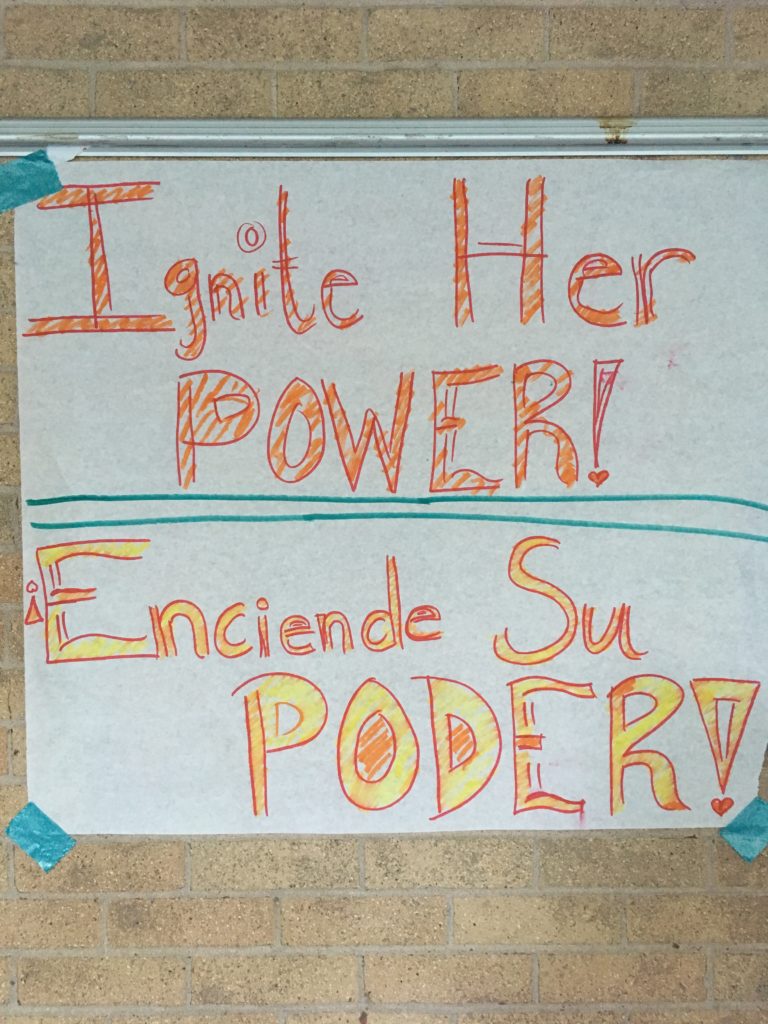
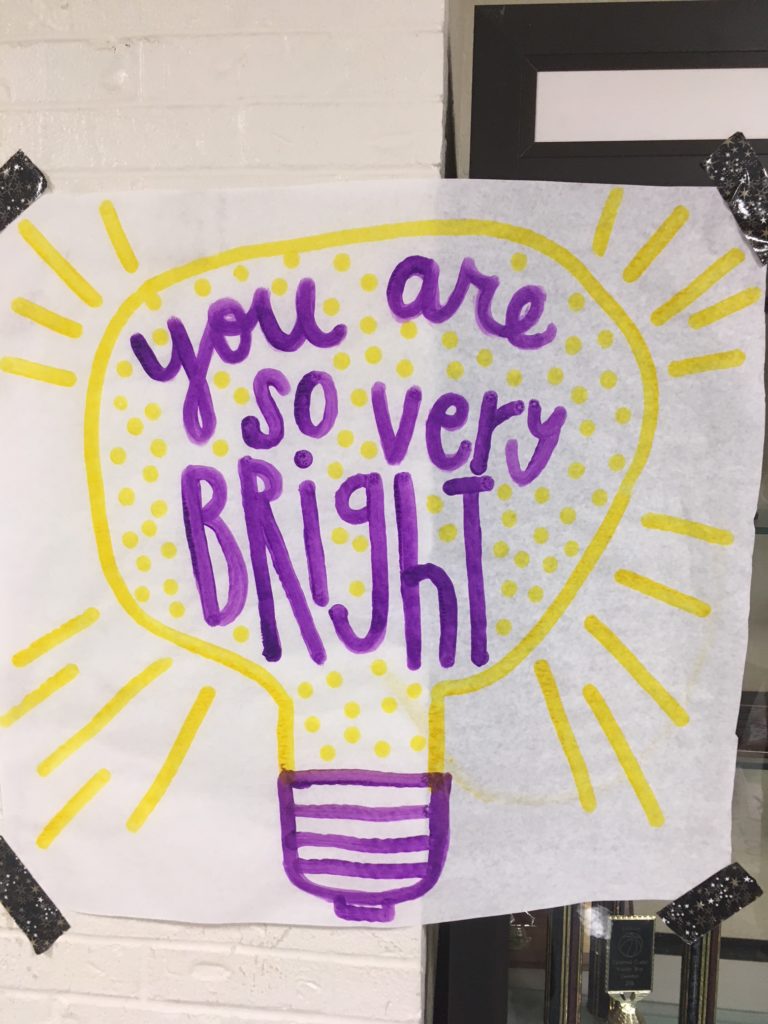
I spent this weekend in Austin, Texas where I gave a keynote address to thousands (gulp!) of girls who were attending the Girls Empowerment Network conference and then taught a Dove Self-Esteem Project workshop in three different break-out sessions. The theme for the conference was Ignite Her Power and after spending a day with these delightful girls and their mentors and parents, I feel so fortunate to report that my power was ignited, too—and I had this really incredible lesson about self-care from a 5th grader, too.
During my first workshop, a sweet group of 5th grade classmates joined me. As we worked our way through the activities, I was so touched by how sweet, earnest, and innocent they were. For our closing activity, each girl was asked to draw a picture of herself doing something that she loved to do and then, in our closing circle, she would share her drawing, what she loved to do, why she loved it, and how it was a celebration of who she is and her body.
Stephanie drew a darling picture of herself sleeping and when she shared, she said that what she loved about sleeping was that it gave her the energy to go do all the other things she loved when she woke up. She said, “I think sleep is kinda like charging your phone battery. Your phone is a way that you can do a lot of fun things but the battery gets worn down. If you let it wear completely down, then you can’t do anything fun with it and it takes forever to charge. But if you keep it charged, then you can keep going back and doing that thing you love.”
Um. Is the modern day metaphor for put your oxygen mask on first before helping others or what? And Stephanie doesn’t even have her own phone, she was just sorting around in her mind how to describe why sleep mattered and came up with this spot on metaphor—one that personally encapsulated Ignite Her Power.
A busy time of year is upon us and we’ll all be tempted to push ourselves to get it all done. If we aren’t careful, that might mean we’re running on little sleep and nourishment (actual food and water nourishment and soul nourishment, too). If we do that, we’ll find ourselves worn out and resenting rather than enjoying the season.
So follow Stephanie’s advice and take good care of yourself, dear ones. Your energy is a precious but finite resource.
Preparing for Presence
After my mamacita passed away, I sat down with the priest to plan the funeral. He was a relatively new priest and didn’t know my parents well since their volunteering had started winding down in their 70s.
“Tell me about your mother.” He encouraged and I shared stories about her gardening and grandparenting. It was while we were talking about my mamacita as a grandmother that something struck me, something I had never really observed or characterized in this way.
“She was profoundly present.”
If you were sitting with my mom, you were all she focused on. This presence was an incredible gift to her grandchildren.
I’m not present like that, I remember thinking. And even though I knew that where I was in life at the time-teaching university classes, writing, facilitating workshops and retreats, helping to lead a non-profit, parenting, partnering, etc.– meant many balls had to be in the air at once (a perfect storm for split attention), I didn’t like that that was true.
I yearned to cultivate more of the presence my mamacita embodied, as a gift to me and those around me and also as a way of honoring her life. To me, that presence reflected a purity of choice, of being heart-led, of distilling. I am efficient and productive and while those traits can be strengths, they can also be weaknesses. I wanted greater balance, more intention, more heart. But you don’t just get to greater presence by saying you want it. Or I don’t. I had to prepare for it, make changes for it, choose presence over and over again.
In thinking about what I needed to do to be more present, I knew that one of my challenges was how overcommitted I was. Ultimately, I knew my life, and, more specifically, my responsibilities, needed to be smaller in order for me to practice the presence I desired. So, I evaluated what needed to be downsized or released in order for me to practice more presence. Many commitments weren’t ones I felt I could immediately give up, but I deliberately thought about the soonest time possible for a break.
I also relentlessly recommitted myself to The Wholehearted Continuum (for those of you who aren’t familiar with my WHC, it’s a litmus test I came up with years ago to help me discern whether or not I should say yes to any sort of opportunity). Because my default tendency is to say all the yeses, I periodically backslide in my wholeheartedness practice and have to go back to deliberately walking myself through each step of the WHC before making a decision. I started keeping list of things to which I had said no to remind me of how I was paving the way to greater presence. With every observation, no, and change in responsibilities, I relished the deepening in presence that it brought me.
Moreover, when Happy complained to me last year that “I was always on my phone”, I decided to take a closer look at his point of view rather than dismiss him out of pocket. In the grand scheme of things, I didn’t consider myself a big phone user. In fact, during my workday (which is while Happy is at school), I likely wasn’t on an app on my phone for more than 20 minutes total in the day. I have so few minutes to work and so much work to do that I just don’t have time for that. But, if I was honest, after Happy and I shared snack time (where he told me about his day) and went through his homework, I started dinner as he finished his homework, calling me over when he needed me to check something. In those minutes while the oven was preheating and the onions were browning, I found myself lost in my phone. So, no, I wasn’t on my phone all that much during the day but TO HAPPY, I was on the phone the only time it mattered, when I was supposed to be mostly tending to him (while also please cooking him a great dinner). Seeing my phone use through Happy’s eyes made me realize he had a point and I started putting it away during that time which meant I was practicing even more presence where it mattered.
I pulled my journal back out and used it as a place to capture my intentions, the actions that could support my intentions, my values, how I wanted to those values to show up in my life and more.
A final change that liberated me came from realizing that a quirk of my personality is to fixate on the next big thing coming up, often to the detriment of other things I want to be doing. For example, if I am flying out of town at two in the afternoon, I would get to the airport super early just in case, letting things that I might have done that morning to care for myself (things that reasonably I had time to do) or be in company with others slide off the to do list so that I could be sitting at my gate hours and hours early. This fixation on the next big thing on my schedule meant I often deny myself the ability to practice presence in other ways. I eventually observed the disservice of this practice enough that I decided that despite my anxiety and the discomfort of having less time cushion, I could indeed divide my energy and lessen my hyper-focus. By asking myself if this tendency/quirk allowed me to be my best self and thrive, I realized I was actually making my life smaller and giving myself less ways to be present.
Recently, I came across a note that I scrawled in response to a prompt that I gave in a writing class I thought years ago.
The prompt was simply: I am a woman/man/person who… 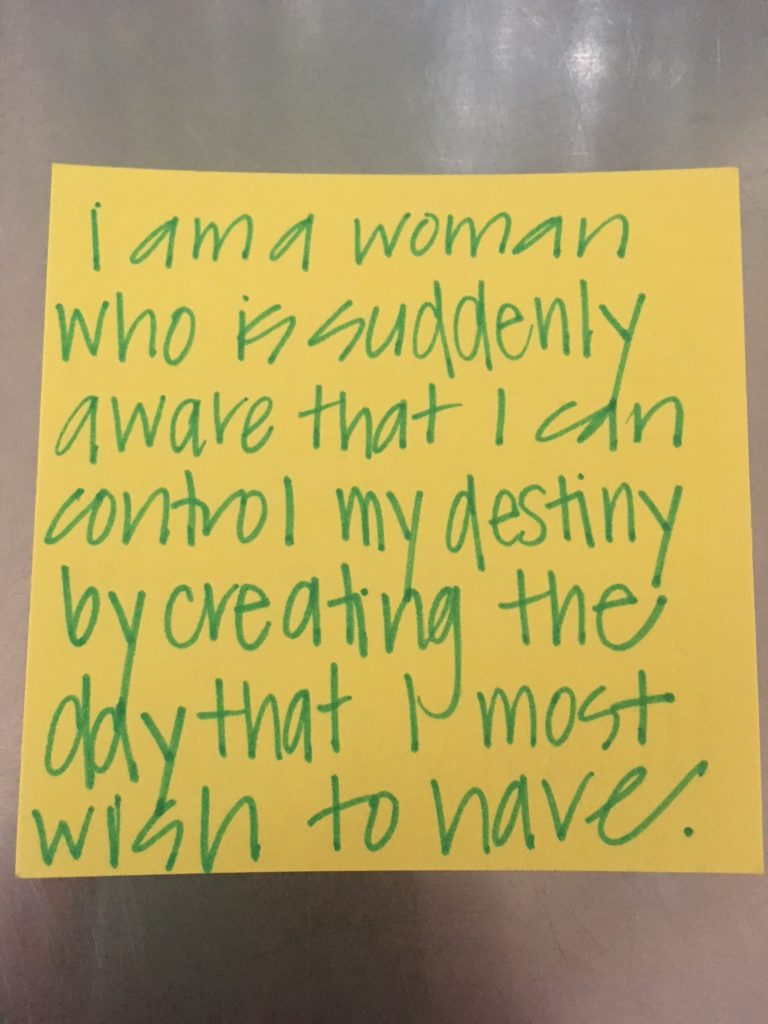
and I wrote: I am a woman who is suddenly aware that I can control my destiny by creating the day that I most wish to have.
What I know now is that the day that I most wish to have is far less about the specific things I am doing and more about how I am energetically able to be over the span of hours I have available to me. I want my heart show up in all that I am doing. For you. For me. For my values and beliefs and the possibilities before me and the most profound way that I can do that is by choosing the behaviors that allow be to be present over and over again.
What do you want to be practicing in your life these days?
How can you prepare to move towards that feeling?